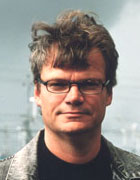
Oscar Hemer
 |
oscar.hemer@mah.se School of Arts and Communication (K3) Malmö University +46 40 6657 223 |
Writing as Exploration and Means of Social Change
I am professor in Journalistic and Literary Creation, and the initiator and coordinator of the Master programme in Communication for Development at Malmö University.
Co-Director, and supervisor of one of the two first interregional PhDs, under the headline “Histories and Dynamics of Globalization, Communication and Development.”
I am a writer of fiction and non-fiction, and my reearch area is in the crossroads of Anthropology and literary writing, with a certain focus on memory and representations of violent conflict.
My first novel, Coyote, was published in 1983. It tells the story of a young man’s yearlong odyssey through Latin America in the mid 1970s. My sixth novel, Misiones, is to be published in 2014.
Apart from novels, I have written several books of essay and reportage and worked as an arts journalist and editor in different media – predominantly newspapers. I have also done some literary translation on the side, mainly from Spanish.
My extensive travels to many parts of the world, Latin America in particular but also Africa and Asia, play an important role in my work, both as a fiction writer and as a journalist.
I spent two decisive years in Ethiopia in the late 1980s. In 2000, I quit as arts editor of Sydsvenska Dagbladet and started my late academic career.
In 2007, I embarked on a research project entitled Fiction’s Truth. It investigated fiction as a research method and a means of communication for social change, with South Africa and Argentina as case studies, and eventually led to my dissertation in Social Anthopology at the University of Oslo, Norway, in 2011. A modified version of the dissertation was published as Fiction and Truth in Transition : Writing the present past in South Africa and Argentina (Lit Verlag, 2012).
In 2012 I became Professor and I am currently working on a hybrid genre that I am tentatively calling “ethnographic fictions.”
Contact me for issues concerning the ComDev master, and research ideas with ethnographic and/or artistic components.
Selected Publications
Oscar Hemer: Misiones (forthcoming), the concluding novel of my Argentina trilogy (Cosmos & Aska, 2000; Santiago, 2007)
Oscar Hemer: Fiction and Truth in Transition : Writing the present past in South Africa and Argentina, Lit Verlag, 2012
Oscar Hemer et al.: “Hillbrow Blues”, in Chapman, Michael (ed.), Africa Inside Out : Stories, tales and testimonies, University of KwaZulu-Natal Press, 2012
Oscar Hemer et al.: “Antropologen som författare”, in Norsk Antropologisk Tidskrift 1/2012 (Festskrift till Thomas Hylland Eriksen)
 New PhD opportunities at the University of Leicester
 Call for Abstracts: New Directions in Media, Communication and Sociology (NDiMS) Conference
 Ørecomm Team to Gather at the University of Coimbra
 “Communication and Social Change – A Citizen Perspective” Published
 C4D Network to Sum Up Global Communication for Development Practice
 Entering Media and Communication into Development Conferences?
 IAMCR Conference 2016: Communication for Development Highlights
 Glocal Classroom Revisited – Storytelling & Social Change Leicester-Malmö
 I EvalComDev International Conference: Call for Papers
 Looking for Media and Communication in Development Conferences: Devres 2016